(I’m adding this post to demitastes.com on 2023-10-20. Exactly 1 year and 1 month ago, on 2022-09-20, this article was originally posted on Medium before I had my own website. Since this is one of my larger and more important pieces of writing, it felt worth adding to my blog ASAP.)

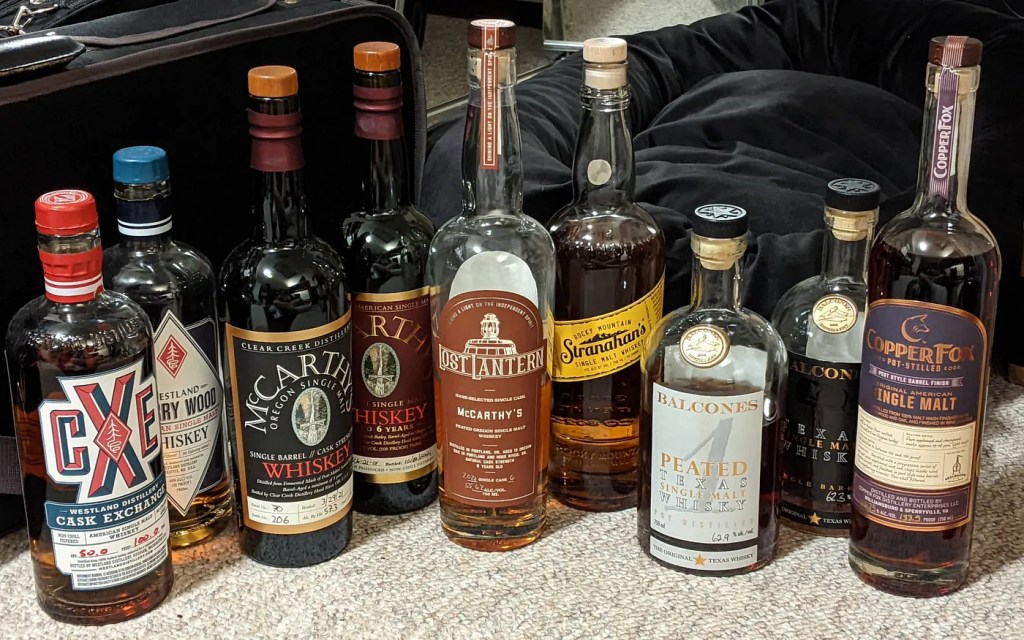
Pictured: A selection of American Single Malt Whiskey from producers across the country: Westland (Washington), McCarthy’s (Oregon), Lost Lantern (an Independent Bottler), Stranahan’s (Colorado), Balcones (Texas), and Copper Fox (Virginia)
On July 29th, 2022, the TTB published their notice of proposed rulemaking for the addition of American Single Malt Whiskey (ASMW) to the Standards of Identity. There has already been plenty of discussion, and a fair amount of confusion, about what all this means.
I’d like to take this opportunity to clear the air and give you the information you need to constructively voice your opinions with the TTB.
Before we start from the beginning, let me just say that if you’re riled up about “coloring, flavoring, and blending materials”, well, I am too. Bear with me, I’ll get to that, and hopefully I’ll provide you with some helpful context along the way.
Register Your Comments
First things first, you should know that you can voice your comments with the TTB on this matter, but only until the public comment period closes on September 27th, 2022. The TTB wants to hear from consumers like you in addition to producers. We are all in this together.
By the end of this article, I hope you’ll have everything you need to voice your support for, and suggested adjustments to, the proposed rules for ASMW.
To submit your comments about the TTB’s proposed rules for ASMW just follow the instructions on the page. You can also read others’ public comments there as well.
This is the Beginning of the Conversation
At the conclusion of the comment period on September 27th, the TTB will take the public comments and consider changes and additions as supported by the public. The comment period for this proposal is fairly short, and the period is already drawing to a close. There has already been a lot of discussion and broad industry consensus via the ASMW-producing members of the ASMWC, and the TTB has reacted to that and taken this proposal with particular priority, moving quickly, such that there is a good chance the rules could be finalized by the end of the year.
I hope you’ll agree that the proposed rules are at least a good starting point, and are worth discussion and adjustment. If you broadly agree that defining rules for ASMW is a good thing compared to the status quo, and that this proposal more or less feels like it would achieve that goal, then please be intentional to make the content of your comments reflect your positivity as well as any criticism, so we don’t end up back at square one with a cancelled proposal.
I invite you to keep your mind open to the practical compromises that were made in this proposal so that ASMW could fit broadly into the existing rules for Whiskey in the United States, while also broadly satisfying a globally-acceptable definition for Single Malt Whiskey.
Whiskey, in Plain English
Let’s get into what this legal proposal is all about. First, some background context.
Broadly speaking, the world considers “whiskey” (or “whisky” [*]) to be a spirit distilled from grain and aged in wood. If it isn’t aged in wood, it might be called “new make”, “white dog”, or “moonshine”. If it’s made from fruit, the spirit is called brandy; from agave: tequila, mezcal, etc.; from sugar cane: rum; and so on.
As far as whiskey goes, the type of whiskey is further defined by the types of grains it is made from and in what proportions (this recipe is called a “mashbill”), as well as how it is aged, and a few other technicalities. Almost every whiskey category in the United States is required to be aged in new, charred oak. A mashbill of at least 51% corn produces Bourbon; 51% rye produces Rye Whiskey; 51% malt produces Malt Whiskey, and so on.
The existence of the above definition of “Malt Whiskey” in the United States is an interesting note and helps explain why American Single Malt Whiskey needs the definition it does. More on that later.
In Scotland and most of the rest of the world, there is also a category broadly known as “Single Malt”. “Single Malt” as a phrase collectively means that the whiskey is distilled from 100% malted barley, and comes from a single distillery. In most of the world, the cask type is not restricted beyond “oak”, and in some countries, like Australia, the cask requirement is simply “wood”. Note in particular that “new, charred oak” is not a requirement for Single Malt in most of the world.
By the way, a mashbill can incorporate different varieties of the same type of grain, for example, Westland Distillery in Seattle, Washington uses 5 or 6 types of malted barley (depending on the specific product) in their American Single Malts. So, there’s still plenty of room for developing interesting flavors from the specific choice of grains, even when restricted to just malted barley.
You’re probably used to hearing the term “barrel”. A barrel is a specific size of cask, so I’ll use “cask” as the general term.
Another term we’ll use here is “proof”, which is defined in the U.S. and most of the world as simply two times the percent Alcohol By Volume (ABV). For example, 50% ABV equals 100 proof. (It’s a historical, regulatory, tax thing.)
[*]: The terms “whiskey” and “whisky” are interchangeable in United States regulations. Many countries prefer one spelling over the other. Scotland notably exclusively uses “whisky” for their products. Most of the United States uses “whiskey”. I will try to use a country’s preferred spelling as appropriate.
What is “Single Malt”?
If you’re already familiar with what “single malt” means both in Scotland and in the context of the ASMW proposal, feel free to skip over this section.
For the uninitiated, let’s try our best to make this clear. It is really difficult and confusing to completely explain what “single malt” is in the context of American whiskey, while also doing justice to the existence of malt whiskey, or without talking about Scotland. So, let’s cover those bases.
In simple terms, in Scotland, there is “malt whisky” and there is “grain whisky”. If it’s made from 100% malted barley and distilled on a pot still, it’s “malt whisky”; otherwise, it’s “grain whisky”.
Note, we haven’t mentioned “single” yet.
Scotland has a tradition and history of merchants buying whisky from multiple distilleries and blending to a target flavor profile. The result of mixing distilleries is “blended whisky”. There’s also “blended malt whisky” and “blended grain whisky” if the whisky types aren’t mixed.
In Scotland, essentially, the opposite of “blended” is “single”, meaning, it comes from a single distillery. There is no “double malt”, etc.
That was easy, right?
Unfortunately, “single malt” in the rest of the world doesn’t necessarily share this etymology. American whiskey certainly doesn’t. This isn’t (just) because Americans are difficult — it’s more that modern whiskey as we know it came into being in different ways, in several countries, around the same time, several centuries ago, when rapid global communication and standardization weren’t really “a thing” yet.
Essentially by default, American distillers release their own products, and there has never been a definition of the term “single”. “Blended” has a definition, sure — but it’s about additives, or the mixing of types of whiskey (rather than different distilleries), and/or the mixing of whiskey from different regions. This is almost entirely not compatible with the Scottish definition of “blended”. “Blended” as it pertains to American regulations and ASMW will be a separate challenge, to be discussed more later.
Even more confusingly, the United States already has a definition of “malt whiskey”, made from at least 51% malted barley rather than strictly 100%, and is therefore not equivalent to Scottish “malt whisky”. Only a subset of American “malt whiskey” which is 100% malted barley is compatible with the idea of “single malt whiskey” as popularized by Scotland.
So, in the proposed definition of American Single Malt Whiskey, we are effectively defining the phrase “single malt” to get us as close as possible, within existing American regulations, to the definition of Single Malt Scotch Whisky, without worrying about the words “single” and “malt” separately from each other.
Relative to other types of American Whiskey, the American Single Malt Whiskey proposal is specifying the requirements that collectively feel like “single malt,” globally, as well as relaxing the cask type restriction from “new, charred oak” to simply “oak,” to align with common practice for world single malts.
- Distilled from 100% malted barley (a “single” type of grain, if you like)
- Distilled at a single distillery
- Aged in any type of oak cask
What Rules Apply to American Single Malt Today?
American Single Malt Whiskey today does not have a legal definition, per se, and yet there are numerous products marketed as American Single Malt. What gives? Notably, the phrase “American Single Malt Whiskey” cannot currently appear on a label on a single line because that phrase lacks a definition as a type of whiskey.
Currently, products that fit the proposed standard for American Single Malt Whiskey fall into two broad legal labeling categories:
1: “Malt Whiskey”: Products that are aged in new, charred oak casks, distilled from a mash of least 51% malted barley (in this case, 100% malted barley), distilled to no more than 160 proof, and barreled at no more than 125 proof.
- If these products are at least 2 years old and contain no additives, they also qualify to be labeled as “Straight Malt Whiskey”.
- If these products are further at least 4 years old, produced in a single distilling season under a single master distiller, and bottled at 100 proof, they also qualify to be labeled as “Bottled in Bond”.
- This is a long-standing category in the United States, but is more restrictive on cask type and less restrictive on mashbill than the generally accepted definition for “Single Malt”.
2: Simply, “Whiskey”: Products that do not use new, charred oak, or do not meet one or more of the other technical rules for “Malt Whiskey”.
- This is a much broader category with very few restrictions, meaning that it’s pretty much a free-for-all in terms of the other technical rules listed above. However, because it is broader, this category does encompass all of the generally accepted definition of “Single Malt”.
- Arguably, this permissive “Whiskey” category has the possibility of hurting the integrity of any term (e.g., Single Malt) used for marketing these products.
- These products are ineligible to be called anything more specific than “whiskey”, but for many distilleries, Single Malts that currently only fall under the “Whiskey” category represent the majority of the distinctiveness and creativity that the category of American Single Malt would allow, as well as protect.
- These products are also ineligible for a “straight” designation, which may hurt the perceived integrity of the category.
Despite the lack of formal legal protections so far, the producers of American Single Malt have, by and large, taken it upon themselves to protect the integrity of the term “Single Malt” in the U.S., and have done a great job of ensuring that the category is represented by products which would feel, to consumers, to be authentic examples of the world’s definition of “Single Malt”.
The ASMWC’s Proposed Rules, in Plain English
Well, at least in “Plain English” for a whiskey enthusiast. We tend to be a pedantic bunch.
Once the ASMWC internally had more or less a consensus on what they wanted the rules to be, they published their proposed rules on their website in “plain English”, copied here for convenience:
- MADE FROM 100% MALTED BARLEY
- DISTILLED ENTIRELY AT ONE DISTILLERY
- MASHED, DISTILLED AND MATURED IN THE UNITED STATES OF AMERICA
- MATURED IN OAK CASKS OF A CAPACITY NOT EXCEEDING 700 LITERS
- DISTILLED TO NO MORE THAN 160 (U.S.) PROOF (80% ALCOHOL BY VOLUME)
- BOTTLED AT 80 (U.S.) PROOF OR MORE (40% ALCOHOL BY VOLUME)
ASMW Rules Resembling Other American Whiskey Categories
Rule 3, “MASHED, DISTILLED AND MATURED IN THE UNITED STATES OF AMERICA”, means that the alcohol is made and aged in America in a reasonably all-encompassing way. This is consistent with the rules for every other type of whiskey made in the United States. Note that this does allow for some elements “not made here”: the casks, and the raw or malted barley, can come from another country, like Scotland, Canada, or France.
Rule 5, “DISTILLED TO NO MORE THAN 160 (U.S.) PROOF (80% ALCOHOL BY VOLUME)”, is consistent with most other types of whiskey in the United States.
Rule 6, “BOTTLED AT 80 (U.S.) PROOF OR MORE (40% ALCOHOL BY VOLUME)”, is consistent with whiskey products in most of the world.
ASMW Rules Resembling Single Malt Scotch Whisky
Rule 1, “MADE FROM 100% MALTED BARLEY”, is a minimum expectation by consumers worldwide when it comes to Single Malt, and is derived from the Single Malt Scotch Whisky definition. There’s nothing particularly contentious here, as long as we’re defining an American-made “Single Malt” category.
Rule 2, “DISTILLED ENTIRELY AT ONE DISTILLERY”, is another minimum worldwide expectation of the category of Single Malt, per the word “Single” as defined for Scotch Whisky. Interestingly, this is not so far from most American Whiskey Products in practice: essentially the default for American whiskey historically has been for distilleries to bottle their own products without blending with other distilleries’ products. This is in contrast to Scotland’s historical practice of merchants blending scotch whisky from different distilleries to produce blended Scotch whiskies to a target flavor profile, which includes Blended Malt Scotch Whisky, meaning that the liquid comes from multiple distilleries and yet still is comprised of whiskies distilled from 100% malted barley (which is what “malt whisky” means in Scotland).
Rule 4, “MATURED IN OAK CASKS OF A CAPACITY NOT EXCEEDING 700 LITERS”. A requirement for oak casks is a common feature for American whiskey. The cask size limit, however, is a unique requirement that makes American Single Malt technically more restrictive on cask size than other categories of American whiskey.
You might think that limiting the size of the cask is an unnecessary restriction — why box ourselves in on a brand new category? On closer inspection, however, it is worth noting that 700 liters is actually huge! The ubiquitous 53-gallon American Standard Barrel (ASB), the most common size of cask in which the majority of American whiskey is matured, is about 200 liters. 700 liters is nearly 185 gallons! In fact, there is only one, relatively infrequently used, standard size of cask larger than this limit, which is known as a “Tun” and holds around 950 liters. In fact, the Scotch Whisky Regulations, item 3.(1)c requires casks no larger than 700 liters. In Scotch whisky, “tuns” are generally only used for “marrying” (or “resting”, or “mingling”) a batch of barrels to produce a uniform flavor before bottling.
The cask size limit of 700 liters is actually less about a practical restriction and more a nod to the Scotch Whisky Regulations, since Single Malt Scotch Whisky is the inspiration and derivation of many of the commonly accepted rules for the Single Malt category worldwide.
When I spoke with Jared Himstedt of Balcones Distilling in Waco, Texas, he mentioned that while Balcones, for example, typically uses casks slightly larger than the standard 53-gallon barrels, they typically stay fairly close to that size with their 57-gallon barrels. Despite the extreme heat and seasonal temperature fluctuations in central Texas, Balcones has essentially no concern about reaching their target ages and flavor profiles with casks close to the standard size, let alone under the 700 liter limit, particularly when using casks other than new, charred oak casks. In fact, 700 liters is so large that moving such casks is particularly unwieldy: it would make more sense to empty them in place in the warehouse, which would present a challenge for blending and bottling.
Sure, 700 liters might feel weird and random and relatively pointless in the context of American regulations, but it’s acknowledging the source of the Single Malt tradition, as well as making American Single Malt Whiskey products easily marketable as Single Malt Whiskey in other countries which do have such a requirement, thus easily opening up the market for American Single Malt in countries like Scotland.
ASMW Rules that are a Bit Different From Other American Whiskey
ASMW Has No Cask Type Restriction
Most types of American whiskey (bourbon, rye, etc.) are required to be aged in new, charred oak casks. Notably, there is no explicit mention in these six rules of a restriction on cask type, other than “oak”. This is, in fact, intentional, and a major point of differentiation from most other types of American Whiskey. This is not unprecedented: Corn Whiskey and Light Whiskey are granted a similar affordance for “used or uncharred new oak barrels” (see the Standards of Identity 5.143 Table 1 to Paragraph c).
American Single Malt Whisky will be unique, however, in that it is allowed to use either new, charred oak casks, or any other type of used or uncharred cask, e.g., ex-Bourbon, refill American Single Malt, ex-French-wine casks, or pretty much anything else — as long as the cask is made from oak.
ASMW Has No Maximum Barrel Entry Proof
No explicit maximum barrel entry proof is consistent with Single Malt Scotch Whisky and allows for greater freedom in the ASMW category. With cask types other than new, charred oak, an allowance for a higher barrel entry proof feels appropriate because there is less risk of over-extraction in a used cask, and this allowance is consistent with the resulting possibility of a longer runway for barrel-aging before over-oaking the product or dropping below 40% ABV in climates where proof drops over time.
The implicit maximum barrel entry proof is equal to the maximum distillation proof of 160, and that keeps things from getting too far out of hand.
ASMW Rules that are Less Like Scotch, but More Like American Whiskey
ASMW Has No Still Type Restriction
Also absent from the ASMWC’s proposed rules is a specification of still type. Single Malt Scotch Whisky is specified (item 3.(2)c) to use only pot stills for distillation, whereas American whiskey has no such still restriction. Instead, the spirit of the rule in 5.143(a) that whiskey should have “the taste, aroma, and characteristics generally attributed to whisky”, and the grains from which it is distilled, is essentially protected by the maximum distillation proof of 160.
This is consistent with the fact that much of ASMW production so far has been in craft distilling, which often means that still choice was dictated by what was interesting or available. The ASMWC wanted to embrace the creativity while also not imminently threatening the business plans of the vast majority of ASMW distillers, and this was the easiest way to achieve that, with the side benefit that it opens up the category to a broader definition which allows for that “craft”-style creativity.
ASMW Has No Restriction on Bottling Location
All American whiskey must be distilled and aged in America, but there is no restriction that it be bottled within the United States, and this will extend to American Single Malt Whiskey. For those familiar with Scotland’s requirement that Scotch Whisky be bottled in Scotland, this may seem troubling for the American take on the Single Malt category.
However, taken with the other rules restricting American Whiskey, the implication is that fully-aged ASMW could be transferred to an inert container and exported to foreign markets without continuing to age in another locale or being otherwise modified. As observed by Single Cask Nation, without the extra weight of glass, ASMW can be exported more efficiently to foreign markets, and can be bottled in the locality in which it will be sold. Win-win! This will help limit costs and, theoretically, environmental impact.
ASMW Has No Minimum Age Requirement
Perhaps one of the most surprising, and contentious, issues in the ASMWC’s proposed rules is that, similar to other types of American Whiskey, there is no minimum age requirement on ASMW, other than that it must be “stored in oak” for a non-zero length of time. Some “white whiskey” products cheekily proclaim on their labels that the whiskey has been aged in oak for 15 minutes — it counts!
Unless, that is, you want to label your product “straight” whiskey. Or, if you want to sell your product as whiskey in a country that does have an age requirement, like Scotland’s 3-year minimum.
Despite the break from global tradition, this omission of a minimum age is intentional. For one thing, it’s about regulatory consistency: ASMW should fit with other American spirits where it makes sense, and no other non-”straight” whiskey has a minimum age. For producers, it’s a practical concern: while Scotland has the “luxury” of aging in a cool and temperate climate, some climates in the United States are quite extreme, like the high heat and humidity in Texas, or the dry deserts of the American Southwest in states like New Mexico and Colorado, with their daily temperature swings from hot days to cold nights. Check out Balcones’ portfolio of cola-dark whiskeys, for example, many of which are aged only 2 or 3 years. The ASMWC wants ASMW producers to have the freedom to bottle their products when the producers decide they are ready, rather than when they achieve an arbitrary minimum age.
… but wait, there’s no talk above of specifying a “straight” American Single Malt Whiskey designation. That might be a problem…. We’ll get to that a bit later.
The TTB’s Proposed Rules for ASMW
Of course, the hard work of turning these relatively simple rules into an addition to a regulatory standards document that crosses all the ‘t’s and dots all the ‘i’s can be quite an undertaking. Take it from someone with experience contributing to standards text, it’s a giant pain to understand, let alone write, standards text. That’s perhaps where we run into some confusion in understanding the implications of exactly what was written here.
The good news is that the TTB overall did a great job: the proposed rules, despite their beautiful brevity, encapsulate all of the ASMWC’s proposed rules as well as all of the less-explicitly stated points above. However, there are a few notable points in the regulatory verbiage (or its omissions) that were not explicitly proposed or discussed above.
Warning: we’re about to get into the weeds a bit.
On the Issue of Coloring, Flavoring, and Blending Materials
Let’s tackle the elephant in the room. One of the most conspicuous and controversial things in the proposed standard, is, of course:
Allowable coloring, flavoring, blending materials permitted: YES
Yikes.
[ Everyone disliked that. ]
I had a visceral reaction to this, as I’m sure, did many who read the text of the proposal, at least initially. After a lot of consideration, the short version is I think we should push back on this. However, I’d like to at least give some context to show that this wasn’t so much “intentional” as it was “default”, and that is encouraging in terms of our hopes of getting it changed.
Before we get into it, the good news is that the TTB invited comments on this point, and that’s again encouraging:
Should the use of coloring, flavoring, or blending materials be allowed in the production of American single malt whisky? If so, what coloring, flavoring, or blending materials are “customarily employed” in the production of American single malt whisky, in accordance with 27 CFR 5.155? Please provide any available evidence of their use.
Ultimately, my answer is:
“No, because there aren’t any such materials customarily employed in the production of American Single Malt Whiskey, to my knowledge; furthermore, with the exception of e150a caramel coloring there are no such materials customarily employed in the production of Single Malt throughout the world.”
But, let’s entertain the current proposal text for a moment.
Consider what exists in the realm of American Whiskey today: flavored whiskey exists, as does the “straight” designation itself, meaning essentially that the product is “pure” and meets a minimum age requirement.
Suddenly, I feel there’s a common theme in the contentious points mentioned so far…
It turns out that even among savvy drinkers, “American whiskey” is often synonymous with “bourbon” and we sometimes casually attribute rules about bourbon to other categories as well. As Jared Himstedt pointed out to me, it turns out that the base, non-”straight” designation of bourbon is special in this regard. It’s almost obvious when you look closely at the entry for “bourbon” in the Standards of Identity 5.143 Table 1 for Paragraph c “Types of Whisky…” (emphasis mine):
Type: (2) Bourbon Whisky, Rye Whisky, Wheat Whisky, Malt Whisky, Rye Malt Whisky, or [name of other grain] Whisky
Allowable coloring, flavoring, blending materials permitted: Yes, except for bourbon whisky.
With a further careful reading, we find that bourbon is the only non-”straight”, non-”Bottled in Bond” designation that forbids these additives.
By the way, now’s a great time to point out that each type of “straight” whiskey is it’s own entry in the “Types of Whisky” table which is separately specified. The missing “straight” designation for ASMW is again “default” rather than “intentional”; we’ll come back to that.
Bourbon does enjoy a special place in the hearts and minds of drinkers worldwide as the current “quintessential” American whiskey. It makes sense that it is unique and special in the Standards of Identity for American Whiskey. The support of bourbon producers across the United States was instrumental in bringing this proposal to light. Given all that, it makes sense that the initial proposal for American Single Malt Whiskey isn’t suggesting to add a similar exception for itself.
That doesn’t mean we shouldn’t ask nicely.
But even if ASMW doesn’t ultimately get the distinction of being equal to bourbon in this regulatory respect of forbidding additives, let’s take a look at what this would actually allow.
First, some definitions: see Section 5.155 “Alteration of class and type” clauses (a)(1), and (b)(2):
5.155(a)(1): Coloring, flavoring, or blending material. For the purposes of this section, the term “coloring, flavoring, or blending material” means a harmless substance that is an essential component of the class or type of distilled spirits to which it is added; or a harmless substance, such as caramel, straight malt or straight rye malt whiskies, fruit juices, sugar, infusion of oak chips when approved by the Administrator, or wine, that is not an essential component part of the distilled spirits product to which it is added but which is customarily employed in the product in accordance with established trade usage.
5.155(b)(2): Coloring, flavoring, and blending materials that are not essential component parts of the distilled spirits to which added, provided that such coloring, flavoring, or blending materials do not total more than 2.5 percent by volume of the finished product
With those definitions in mind let’s take a look at these potential alterations.
Coloring
Single Malt Scotch Whisky allows coloring, albeit only the high-quality caramel coloring, e150a. However, I think a lot of us are used to the idea that American Whiskey by and large doesn’t allow coloring, “so why should ASMW?” — see above: there’s a lot of bourbon and “straight” whiskey out there, which takes up a significant mindshare among drinkers of American whiskey. In reality, it’s allowed for most non-”straight” whiskey.
Coloring wouldn’t technically be limited to e150a, but it would be limited to 2.5% by volume — well, yeah, okay, that seems like a lot — but let’s keep that in mind, put down our pitchforks, and move on for a moment.
I could see a strong argument for allowing only e150a as an added coloring in American Single Malt Whiskey, for consistency with Single Malt Scotch Whisky — but I’d just as soon avoid the regulatory complexity and the unique special case and just say, “let’s not allow coloring at all”.
Flavoring, and Blending Materials
Per the above definitions, we’re not talking about the often infamous “flavored whiskeys” here. We’re talking about a maximum of 2.5% by volume total modifications including such things as added sugar (as in the case of rum), infusion of oak chips (as in the case of some whiskeys), and addition of wine (which, I think, is a feature of Canadian Whisky, though I am far from expert on Canadian regulations). Rum drinkers will certainly argue that the allowance for added sugar has tarnished the reputation of the rum category. There’s something to that.
This is far from the outrage I initially imagined, but in my opinion, this is something worth pushing back on.
The Real Issue: No Definition of “Straight” American Single Malt Whiskey
The omission of a definition for “Straight” American Single Malt Whiskey was, in my opinion, more of a default action than a deliberate signal that it is not to be, as it will be specified in an additional row of the Types of Whisky table.
I don’t know about you, but I think I’d actually be okay with all of the above, ultimately, as long as we can get a specification for a “straight” American Single Malt Whiskey category consistent with other “straight” whiskeys, which would forbid additives and specify a minimum age of 2 years.
Sure, that wouldn’t be the 3 year age minimum desired by some, so it wouldn’t entirely address the perceived issue that age requirements are different for American Single Malt Whiskey than for Single Malt Scotch Whisky. But, then again, there’s value in being consistent with existing regulations. Consider that one of the responsibilities of the TTB is to ensure that consumers clearly understand what they’re buying when they read a label. The more special cases there are, the more difficult that job becomes.
Encouragingly, this is exactly one of the questions the TTB posed to the public:
Should TTB amend its regulations to allow for the designation “straight” to be used with American Single Malt Whisky?
My answer: A resounding “yes!”
“Blended American Single Malt Whiskey”
Edit: The original version of this article unintentionally included a stub section here from an early draft. I do have detailed thoughts on this, but that update is in progress. For now, it will suffice to say the following:
We think that there should be a definition for a product type that is a combination of ASMW from more than one distillery, and nothing else, similar to the meaning of “Blended Malt Scotch Whisky.” We do not want a “blended” category that follows the pattern and affordances of “blended” for existing types of American Whiskey.
One proposal for the name of such a product would be to use the term “vatted” instead of “blended”, which can either stand in where “blended” would have been in the names, or replace “single”:
Vatted [Straight] American Single Malt Whiskey
[Straight] American Vatted Malt Whiskey
Stay tuned for a detailed analysis in this section. Apologies for the brevity.
“American Single Malt Whiskey”
Yes, “American Single Malt Whiskey”, in quotes: the entire phrase is defined as a unit. If I’m not terribly mistaken, the proposal states that the type of whiskey to be defined is not “Single malt whiskey” but, rather, and I quote from the addition to the table, type number “(15) American Single Malt Whiskey”. That is, it has to include the word “American”. This feels redundant: it’s made in America. Worse, it would cause the names of ASMW from distilleries that want to prominently display their state or region on the label to land flat with a thud instead of ringing like a bell. Consider a few choice examples that specify a state or region and would now have to add “American” to their labels:
- Balcones Texas [American] Single Malt Whiskey
- McCarthy’s Oregon [American] Single Malt Whiskey
- Stranahan’s Rocky Mountain [American] Single Malt Whiskey
The addition of the word “American” to these labels would materially negatively impact the appearance of the labels and the marketing of the products.
In my opinion, this is an absolute must to include in our comments to the TTB, because I think it would be an absolute shame if this significant detail were not adequately considered.
I propose that “American” should either not be required, or that the category should be renamed to “Single Malt Whisky” (without “American”, which is implied), or that, in the presence of the designation of a region or state, such region or state designation supersedes “American” and therefore “American” can be dropped from the label. As currently stated, the proposed rules would require many distilleries to add “American” to their labels which would materially negatively impact the appearance of the labels and the marketing of the products.
A Proposal for Updated Language
Given all of the above points, I would propose the proposal be updated with the following language at the end of paragraph (b):
(b) * * * “American single malt whisky” must be distilled entirely at one U.S. distillery, and must be mashed, distilled, and aged in the United States. Products composed of “American single malt whisky” from more than one distillery and containing nothing in addition to the component “American single malt whiskies” are “American vatted malt whisky”. Products comprised in part of “American single malt whisky” and containing anything other than “American single malt whisky” are not allowed to retain “single malt” or “vatted malt” designations but may fit into other “blended whisky” categories. “American” in the labeling of the preceding types of whisky may be replaced with a more specific place, State, or region (e.g., “Texas Single Malt Whisky”).
Wrapping Up
Thanks for bearing with me through this marathon of regulatory microscopy. I hope that this has been broadly educational as well as helpful in forming your opinions and public comments on the proposed standard for American Single Malt Whiskey.
If it’s not obvious from the sheer amount of words I’ve written on the topic here alone, I should say that I’m beyond excited for this category to finally see the (formalized) light of day. I honestly believe that some of the best whiskeys I’ve ever tasted come from this category, and there’s certainly a high degree of excellence across the board. American Single Malt Whiskey is truly world-class and it’s time it takes the next step into the world.
There are details I would change about the proposal, sure, but by and large I think that this is a tremendous step in the right direction and we’re just nit-picking small, but important, points to ensure that the result will satisfy both producers and consumers around the world, and will stand the test of time.
Now, go forth, and register your comments with the TTB!

 Demi Tastes Whiskey